Clack of the Town: The 3am Snooker Halls Where London Finally Shuts Up
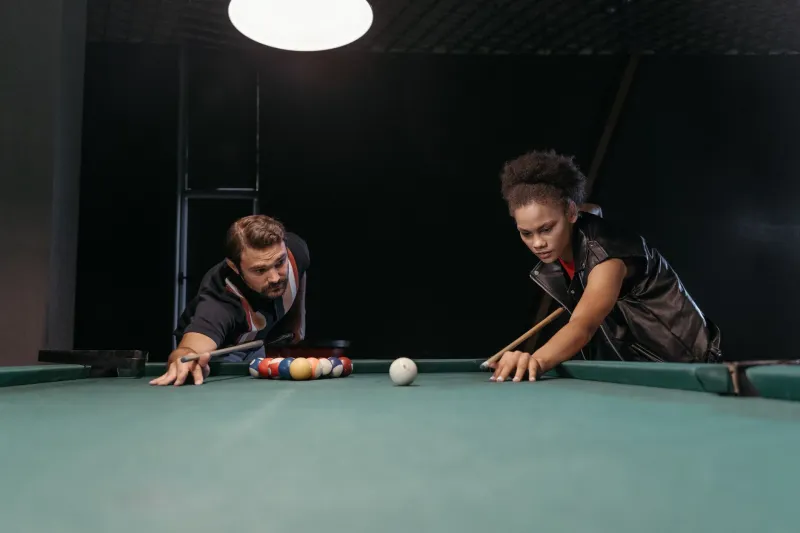
There is a particular London sound that only exists after 2am: the clack of a snooker ball, followed by a soft, apologetic thud as someone misses a easy pink and mutters “oh, for fu—” under their breath. No bassline. No queue. No one asking if you’ve got a lighter. Just fluorescent light, a worn cue and the distant kettle of a bloke who has been playing the same frame since Tuesday.
Welcome to the city’s last quiet rooms. Not quiet in the library sense — snooker halls are full of coughs, cues against radiators and the occasional existential sigh — but quiet in the way a pub never is after 11pm. The TV is on mute. The carpet has seen things. And the only person trying to sell you anything is the chap behind the counter, who would quite like you to pay for your table before the sun comes up.
The anti-pub
London’s late-night snooker halls are the anti-nightclub. They are also the anti-“bottomless brunch”, the anti-“immersive experience” and the anti-anything that requires you to book a slot and wear a wristband. Most of them smell faintly of chalk and old carpet. Some have a bar that serves cans. One or two have a proper kitchen serving toasties with the urgency of a regional airport. All of them have a clock that seems to run on a different temporal plane.
The appeal is obvious once you’ve been. A snooker hall at 3am is a place where you can be alone without being lonely, or social without being perceived. You can play badly. You can play in silence. You can have the kind of conversation that only happens when two people are staring at a table instead of each other. And you can do it for less than the price of a round of disappointing lager in Zone 1.
This is the 10nd0n version of a big night out: not a big night out at all. A small, green, slightly sticky one.
The unwritten rules
Every snooker hall has its own ecosystem, but the etiquette is broadly the same. First: don’t ask for a “table for two” like you’re at Pizza Express. You ask for a table, you pay for an hour, and you get on with it. Second: if someone is practising alone, leave them be unless they look at you like a lost puppy. Third: do not, under any circumstances, lean on the table. Fourth: the person who loses pays for the next hour, unless they are skint, in which case they pay for the teas.
And then there’s the sacred rule of late-night snooker: nobody cares how good you are. The hall is full of people who can clear the table in one visit and people who need three attempts to hit a red. Both are welcome. The only thing that gets you judged is hogging the table when there’s a queue, or putting your pint on the baize. That’s not a faux pas. That’s a war crime.
What it costs
Hourly rates vary wildly. In the suburbs, you might pay £8–£12 an hour per table; in the more central basement clubs, expect £14–£20, with a refundable deposit if you’re a first-timer and look like you might do a runner with a cue. Some places charge per person rather than per table, which is annoying but understandable. Most have a “last table” cut-off that is less of a rule and more of a negotiation.
The bar is where things get interesting. A can of Stella might set you back £4.50. A tea is £1.50 and comes in a mug that has seen more history than the British Museum. A toastie is £6 and arrives when it arrives. Nobody is doing small plates. Nobody is doing “snackable sharing concepts”. It is a crisp packet and a dream.
The regulars
Every late-night snooker hall has a cast of characters. There’s the bloke in the fleece who has been coming since 1987 and has a cue case held together with gaffer tape. There’s the pair of night-shift workers who play three frames before their shift and three after. There’s the student who has discovered that a snooker hall is cheaper than a cinema and quieter than a Wetherspoons. And there’s the mysterious woman who always plays alone, always wins, and always leaves at 4am without saying goodbye.
They are not unfriendly. They are just occupied. The beauty of a snooker hall is that it gives you permission to be left alone. In a city that constantly demands your attention — buy this, drink here, look at this queue — a green baize and a set of balls is a rare thing: a place where the only thing you have to do is take your shot.
Where to rack up after midnight in 2026
A word of warning: late licences are a moveable feast. A place that was 24-hour last month might now shut at 1am because the landlord fell out with the council, or because the owner discovered that running a snooker hall is not, in fact, a licence to print money. Always ring ahead. Always check the website. And always, always bring cash for the table.
| Venue | Vibe | Late-night note |
|---|---|---|
| Cousins Snooker Centre, Tottenham | Proper old-school, fluorescent-lit, no nonsense | Traditionally late; ring to confirm the last table |
| Hurricane Rooms, Finsbury Park | Basement club feel, mixed crowd, good for a post-pub frame | Check weekend cut-off times |
| Selby’s, King’s Cross | Central, slightly shabby, excellent for a 2am existential crisis | Book a table if you’re a group |
| The London Snooker Club, Elephant & Castle | No-frills, friendly, cheap tea | Late openings vary; don’t turn up at 3am without calling |
If none of those work, look for the words “snooker” and “late licence” in the same sentence on Google Maps, then ignore the reviews and go anyway. The best rooms are rarely the ones with a Instagrammable entrance. They’re the ones above a kebab shop, behind a fire door, down a corridor that smells of bleach and ambition.
The last frame
At 3am, a snooker hall is not a night out. It’s a night in, in public. The city outside is still doing its loud, messy thing, but in here the world has shrunk to a table, a cue and the next shot. You will not get a story out of it. You will not meet the love of your life. You will probably miss the brown.
But you will walk out onto the street at 4am with that strange, clean feeling of having done something small and pointless and entirely your own. And in London, in 2026, that’s worth the hourly rate alone.